Crossed roller bearings are vital to robotic and humanoid applications for their ability to provide smooth, reliable movement. Most often used in rotary actuators, they provide seamless rotation in humanoid wrists, elbows and shoulders. Below we dive into the most common questions CCTY receives as a crossed roller bearing manufacturer.
What are crossed roller bearings?
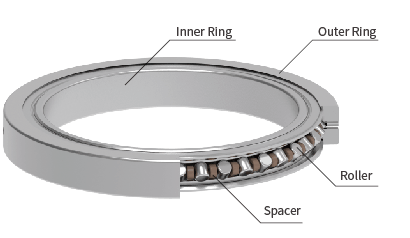
Crossed roller bearings typically consist of an outer ring, inner ring, rollers, and spacers. Spacers separate the rollers, effectively preventing mutual friction between rollers and reducing rotational torque.
Within the crossed roller bearing, the rollers are alternately arranged at 90° angles to each other, enabling the bearing to simultaneously withstand loads from different directions such as axial loads, radial loads, and moment loads. A full complement roller structure can be chosen for heavy loads.
Crossed Roller Bearing Features
- High load capacity
- Compact structure
- High rigidity
- Capable of handling radial, axial and moment loads
- Small clearance or negative clearance
- Optional sealing
Styles of Crossed Roller Bearing
Thin Wall Crossed Roller Bearing (CRAU)
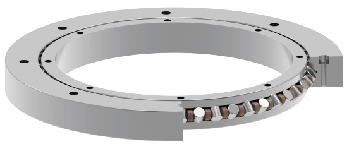
RAU bearing types feature a thin-wall or ultra-thin-wall design. The inner and outer rings have no mounting holes and require flanges and support housing for installation.
Suitable for applications where space is limited.

High Rigidly Crossed Roller Bearing (CRB)
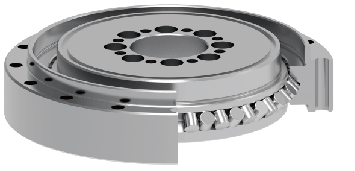
CRB bearings generally have mounting holes in both the inner ring and outer ring. They do not require flanges or support housing, enabling simple and quick installation. Installation has minimal impact on performance, ensuring stable rotational accuracy and rotational torque.
Suitable for applications where high rigidity is required.
Custom Crossed Roller Bearings
Bearings can be designed or modified according to customer requirements to achieve more innovative structures.
Surface treatments can also be applied based on the customer’s specific operating environment, offering greater flexibility to meet diverse customer needs.
How should crossed roller bearings be installed?
Install crossed roller bearings according to the following steps:
- Pre-Installation Check: Wipe the bearing support housing, spindle, or other mounting components to remove oil, dirt, and debris.
- Inserting the Bearing: For bearing installations, keep the bearing level and press over the outer ring into the support housing or press over the inner ring onto the shaft using even pressure. Confirm that the bearing is fully seated against the reference surface.
- For interference fit designs, heating (bearing temperature not exceeding 80°C) or cooling can be used to expand or shrink components for easier assembly.
- Caution: Control the applied force when tapping the bearing; excessive force may cause damage.
- Mounting the Flange: Place the flange onto the bearing, align the bolt holes, and insert the bolts. Tighten the bolts in sequence: first, lightly insert all bolts, then tighten them gradually in a diagonal pattern. Do not fully tighten any single bolt at once.
How often should a crossed roller bearing be lubricated?
- Crossed roller bearings are pre-lubricated with grease upon receipt and can be used directly. Insufficient lubrication will increase friction resistance and reduce service life. Open-type bearings require regular grease replenishment, approximately every 1-6 months. The frequency depends on specific operating conditions.
- When replenishing, use the same type of grease, ensure it is evenly distributed throughout the bearing’s internal components, and avoid mixing different types of grease.
- If the bearing is used in special environments such as high vibration, clean rooms, vacuum, high temperature, or low temperature, standard greases may not be suitable. Special lubricating greases may be required.
What is the normal operating temperature?
The normal operating temperature range for bearings is -20°C to 80°C.
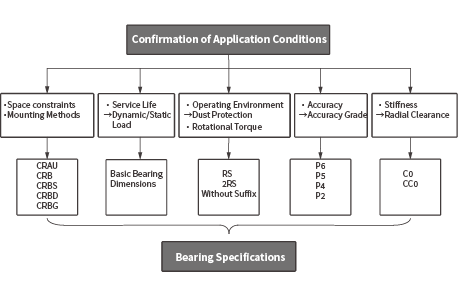
What sequence should I use when choosing a crossed roller bearing?
What crossed roller bearing sizes does CCTY offer?
CCTY offers crossed roller bearings with in a variety of sizes, surface treatments and designs. Contact us to speak with a crossed roller bearing expert.